

Up Close With Award Winning Director Weaam Williams
Impulse team recently caught up with award winning Cape Town based director, Weaam Williams.
Williams is a Muslim woman screen-writer, director and poet. She has found her voice as a woman and activist using cinema.
She is a member of the Film Fatales and owner of Tribal Alchemy Productions, an independent production company which specialises in video and photographic productions.

1. Briefly tell us about yourself and your journey in filmmaking so far
I am an optimist, who is not scared of being confrontational for the right cause. I am soft on the outside, with the heart and strategy of a warrior.
I started performance as a performance poet, and in the theatre live art space. I started writing short stories at high school, my first job was an arts journalist, until I got my first job in the industry as a screen-writer on the SABC drama series, Soul Buddyz.
Thereafter I moved into directing, my first film is a documentary called “Hip-Hop Revolution”
2. Where do you draw inspiration from as a filmmaker?
.
Inspiration comes from everyday life. At different points in time there are different things which inspire me. As a writer, I listen very closely to people and their sub-text, I spend a lot of time observing and listening, as an author.
As an artist and filmmaker I am inspired by many things, I have had an obsession with Korean cinema for a long time and rented every single DVD at the old DVD Nouveau in Cape Town, before we started streaming.
I am also inspired by filmmakers like Nadine Labaki, Jodie Foster, Matt Damon, who write, direct and act.
I am inspired by Haile Gerima as a veteran African filmmaker who showed us it is possible. I remember watching his film “Sankofa” on the big screen and meeting him in Cape Town, he was a bit of a celebrity to us dreadlocked kids at the time.
A few years later I met him in Washington at Sankofa Cafe, my debut film Hip Hop Revolution, made with DOP Nafia Kocks, had sold out screenings at its US Premiere. Some heads who attended the screening invited us over to Sankofa Cafe.
It was serendipitous to find Haille Gerima there, and eat a meal with him. He subsequently acquired a copy of the film “Hip Hop Revolution” for the Howard University Library where he lectured at the time.
I am both drawn to authorship and performance and find fulfillment in both, and are inspired by authors, performers, artists and musicians.
When I need a boost in life I listen to Bob Marley, somehow, it is the most reconciling and uplifting thing for me to do. When I feel happy I listen to Mattafix or Damian Marley. When I want nostalgia I listen to 90’s grunge like Portishead, Mazzi Star etc.
However, these are all very material inspirations, mostly I am inspired by Allah his magnitude, magnificence, wisdom and creation for he puts love and resilience in the heart of the believer.
Ultimately the Sufi believes that the artist is a vessel, and when we surround ourselves with a higher level of consciousness our art is a vehicles of this and for this purpose.

3. How would you describe your style as a director?
My style is very organic, I have honed my skill over the years to use the resources available to execute my vision. I also love French new wave cinema, and its minimalism.
I am very intuitive when it comes to my work, and listen to my inner voice often.
However, directing is also about convincing funders and a team of people to support your vision. Most times, I have been successful in doing so.
My craft in directing is born in authorship, married to an understanding of technology, I am able to see it from the page in my mind’s eye.
I rely on visualisation techniques, archaic story telling methods, intuition and the universal law of attraction.
4. Two Hues, how has the film changed your life since its release?
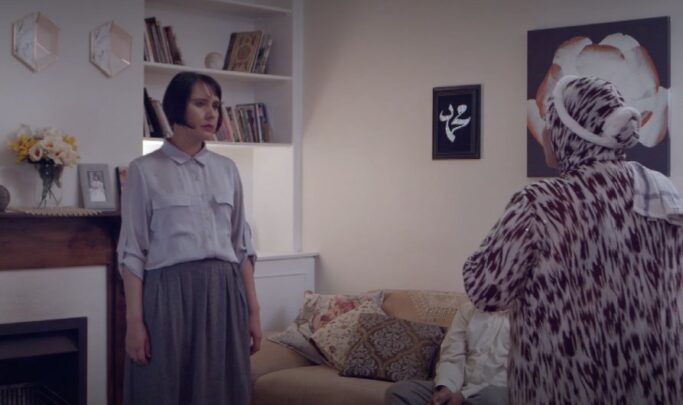
Two Hues, has had a presence in the international independent festival circuit, and it has certainly put more eyes on my work.
I knew that it was going to be a groundbreaking film. Also, undertaking my first on screen acting role has changed my perspective on filmmaking, and artistically fulfilled me in a very different way.
It has been very well received by festival juries, with four awards to date.
5. Two Hues has been a huge success, what would you attribute its success to?
I think there is the synergy between being the author of the character, and playing it, knowing her very well and understanding her psyche.
However, Two Hues is also a great display of an ambitious script with a small budget, and a team of highly skilled professionals bringing on board their expertise.
My co-director, Dominique Josie was great, and assisted with getting into character and delivering the best performances. Nafia Kocks is the DOP and coloursit, and went for a very clean cinematic style with a vibrant colour grade in post.
The film is very stylised and minimalistic, it is not on the nose, with no overtly violent scenes however, speaks volumes in terms of gender based violence, and relies on the subtlety of the script and the performance of the cast.
6. How was the process of taking up the role of director and lead actress on Two Hues?
It was a challenging process, and a lot of self-doubt. However, I remembered a book I read called “The War of Art” by Steven Pressfield.
The author basically encourages artists to embrace their fears, as what we fear most is probably the best move.
So I embraced my fears, and fulfilled my performative yearning in Two Hues. I had been very active in the live art/ poetry/ hip hop space, however, after becoming a director I laid performance to rest for many years.
7. What encouraging words do you have for anyone start out in the music industry
I believe in any industry, it is all about your passion. Not only being passionate but being able to use your talent and abilities to make your goals come to fruition.
Don’t seek for approval, but do allow for constructive criticism, yet remain true to your artistic voice.
Network with like-minded people digitally, and remember that the biggest obstacle to overcome is your own self-doubt and fear.
8. Having won multiple awards for Two Hues mainly international, what are your thoughts on the current state of the film industry in SA?
The South African film industry is both exciting and frustrating. What excites me about the industry is its potential.
I am excited to work as a board member of the Independent Black Filmmaker Collective who are instrumental in changing the power paradigm of race and gender dynamics in the film industry.
I believe it to be a growing collective, with amazing human resource that will permanently change the landscape of the future film industry in South Africa.
What frustrates me about this industry are the gatekeepers and their miniads, the nepotism and the cloak and dagger of some black women who ultimately act in the interest of the “old boys”.
It is difficult to work around such dynamics, and it is therefore why I choose to participate in international competitions, more than local ones as local competitions tend to be corrupted.
It is great to be in competition where my work is viewed with objective eyes, and me winning does not tramp on anybody’s toes or egos as it would in South Africa.
South African awards tend to pay lip service to the gatekeepers and it is applause for mediocrity is destructive to the growth of the industry.
As there are many talented filmmakers who are being suppressed by the status quo.
9. Any projects you are currently working on we can lookout for this year?
Definitely look out for “Two Hues” feature film, my documentary project “The Rise” will also be released in the coming months. I have been working on this one since 2018 and had a work in progress showcase at Cannes Docs in 2019.
I am also collaborating on a couple of other projects with different filmmakers, one which I am very excited about is a screen-play co-written with Tsitsi Dangaremba.
10. What are you most Grateful for right now?
I have so much to be grateful for. I am grateful for my gift as a writer, and my intellect, I am grateful for my health and foresight. I am grateful to the people who support my work. I am grateful for my family, both immediate and extended.
I am grateful that an organization like the IBFC exists. Grateful for the material comforts I have in my life, and would like to see more people have this. I have a grateful heart. Alhamdulliah.


Pingback: Hollywood African Cinema Connection on myco.io this June